
Behaviour Sprints for live policy challenges
Estonian Government Department of Innovation
WORK
Lauren Kelly
Behaviour Sprints
for live policy challenges
SNAPSHOT
The Estonian Government Innovation Lab wanted behavioural science they could use in real policy work. We ran one-day Behaviour Sprints with teams from six ministries on live challenges like vaccination uptake, access to work, and police-community trust.
Each sprint focused on one behaviour that mattered, mapped what was holding the current default in place, then designed practical moves that fit the real workflow.
In one sprint with the Department of Health on vaccination uptake, we discovered trust was built or lost in a thirty-second moment during GP consultations. The team designed consultation scripts and dialogue guides doctors could glance at and use without breaking flow.
Estonian Government
Department of Innovation
Policy Behaviour Sprint

You’ve designed a policy. It’s clear, evidence-based, signed off. Six months later, it’s sitting in someone’s drawer.
This happens more than it should. Not because people are careless. Because they have habits, pressure, competing priorities, the influence of a community. When a policy does not account for those realities, it becomes something people read, nod at, and quietly work around.
The Estonian Government Innovation Department wanted to close that gap. They were spreading behavioural science across ministries, like other governments were doing, but with one key difference. They wanted tools people could use in the middle of real work. Not inspiring lectures. Methods a policy team could pick up when the week gets busy and behaviour change is needed.
That’s what the Behaviour Sprints were for.
“Finally, behavioural science we can actually use. Clear tools, a simple process, and no design background required. We’ve already started applying it across our policy work.”
Daniel Kotsjuba
Designer of Public Services, Estonian Innovation Lab
The work
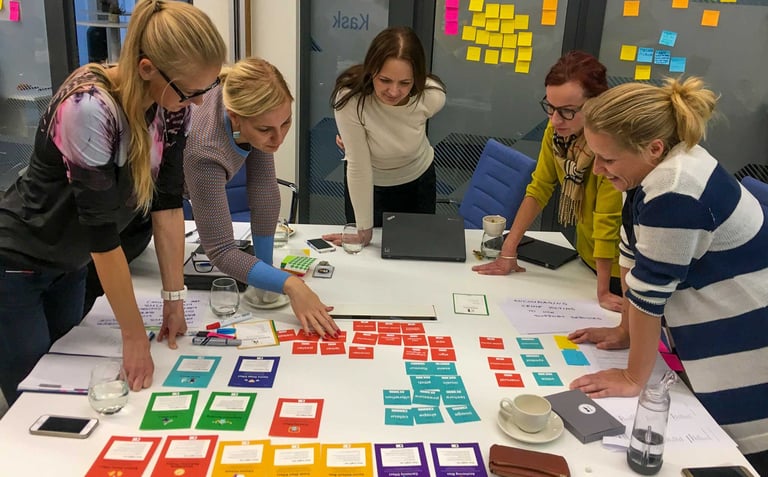
We ran a series of one-day Behaviour Sprints with teams across government. Each sprint tackled a live challenge already on the table, like vaccination uptake, disability access to the workplace, and police-community trust. The people closest to the work were in the room: policy leads, frontline staff, delivery teams.
Every sprint followed the same rhythm.
We picked one behaviour that mattered. The one that would make the policy succeed or stall when turned into a service, experience or campaign.
Then we got specific about the moment it’s decided. Where does the behaviour happen? Who else is there? What do they feel? What are they weighing up? What is competing for their attention?
From there, we mapped what was holding the current default in place. Habits. Friction. Effort. Social risk. Trust. The small pressures that shape what people do, even when they agree with the goal.
Once the team could see the behavioural reality, they ideated new types of ideas. New engagement guidelines, new touch points, new working for internal messaging.
View more work
© 2026, BehaviourStudio All rights reserved. Behaviour Thinking is a registered trademark of BehaviourStudio.