
The first attempt at going digital
What a modular card system taught me about the difference between assembly and routing.
BUILDING BEHAVIOURKIT
Lauren Kelly
12/1/2023
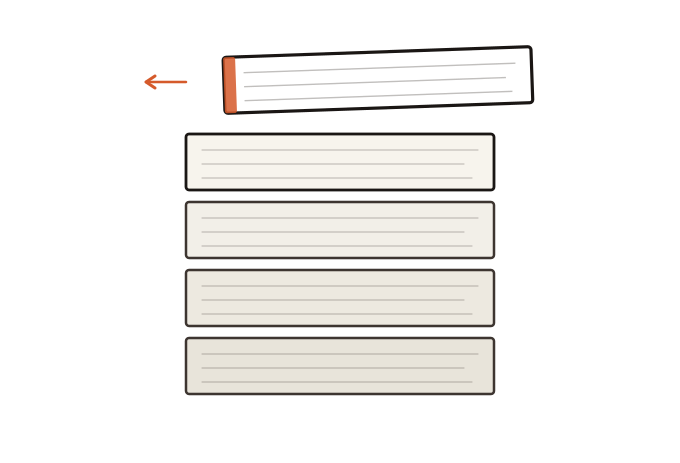
I've been working on the first digital version of BehaviourKit. I'm calling it The Stack, because the core concept is modular layers that stack together into a complete intervention plan.
The idea: you diagnose a barrier, you select a lever, you pick a tactic, you link the evidence, and you export the whole thing as a brief you can share with your team. Three main steps. Under fifteen minutes. That's the constraint I want to design within. If it takes longer than that, the product has failed at the thing it promises.
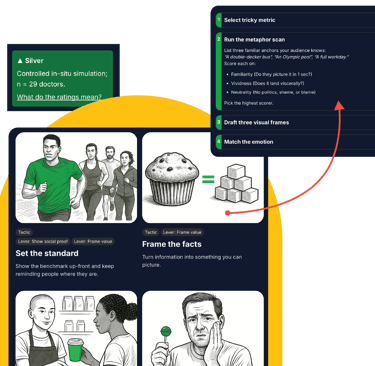
The system now has five layers. Job To Be Done (what you're trying to achieve). Barrier (what's getting in the way). Lever (the behavioural force you're going to use). Tactic (the specific type of move). Evidence (the science and cases that support the choice). Each layer is like a card. You select one from each layer and the stack assembles.
A few things have evolved in the process of designing this.
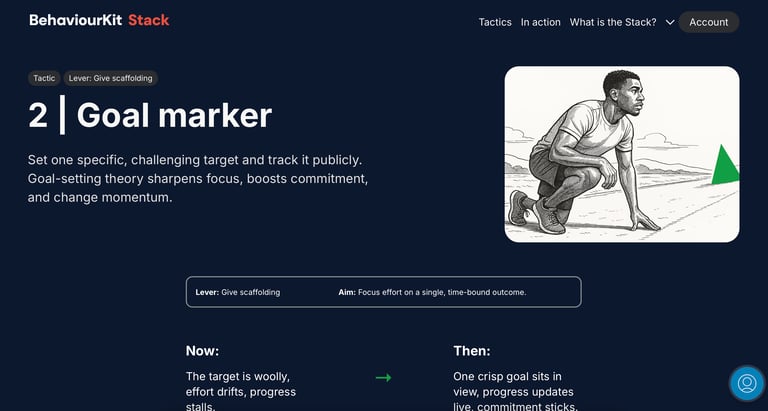
The barriers have expanded from nine to nineteen. The original Drive Grid used nine driver types, which was the right granularity for a facilitated workshop. But a digital system that needs to route automatically needs finer discrimination. "Heart & Mind" is too broad when the system needs to tell the difference between "people's attitudes are negative" and "people's mental model of how this works doesn't match reality." Those are different problems requiring different interventions, and a recommendation engine needs to distinguish between them.
The most interesting new idea is the two-state model. I've started describing each barrier as having a LOW state and a HIGH state, because behaviour doesn't only fail when something is missing. It also fails when something is excessive.
Consider confidence. Too little confidence, and people don't try. Too much confidence, and they skip important steps, underestimate risks, or refuse help. Both are problems. They need different interventions. Low confidence gets "boost" tools, things that build capability and reassurance. High confidence gets "brake" tools, things that introduce useful friction or prompt reflection.
This feels like a genuinely new contribution. Most behavioural frameworks treat their variables as either present or absent, strong or weak. The idea that a driver can fail in both directions, that it has two distinct failure modes, changes how the system thinks about recommendations.
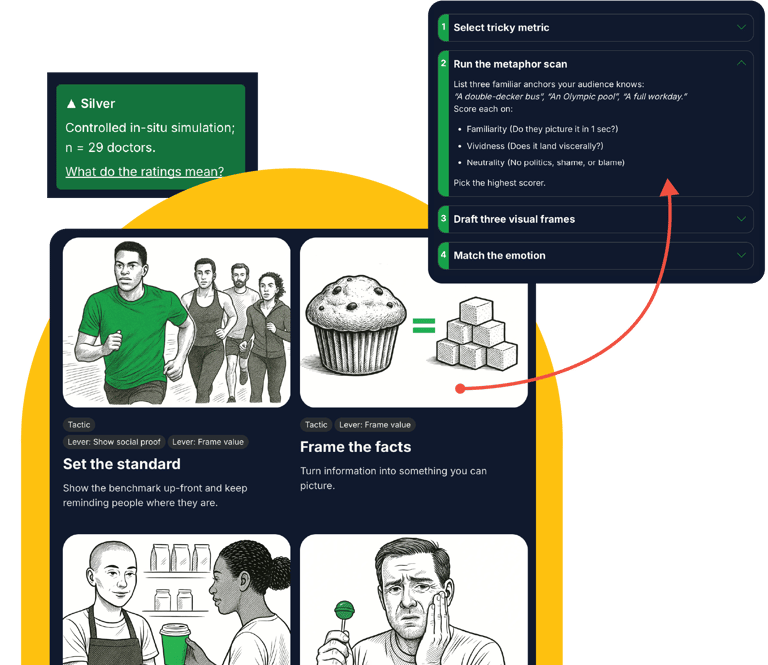
The UX is designed as a three-question wizard. The system asks three questions to identify the barrier and its state. Then you assemble the stack by choosing from the relevant options at each layer. Evidence links automatically. Export to Figma, Jira, or PDF.
I'm excited about the speed. Fifteen minutes from "we have a problem" to "here's a plan we can brief our team on." That's fast enough to be used in a meeting. Fast enough to be used before a meeting. Fast enough that people might actually use it rather than meaning to use it and then running out of time.
But I have a nagging feeling about the assembly step.
"Drag a lever, drop a tactic, auto-link the evidence." That sounds clean. It sounds modern. It sounds like the kind of product interaction that a designer would enjoy. And it assumes that the user understands the system well enough to select the right lever and the right tactic from the options presented.
The whole reason BehaviourKit exists is to serve people who don't have that understanding. People who know they have a behaviour problem but don't know the language or the logic of behavioural science. Asking those people to assemble the right components from a modular system is a bit like asking someone who doesn't read music to compose a chord progression by selecting individual notes from a keyboard.
The technical capability is there. The knowledge to use it well isn't.
I keep coming back to the distinction between assembly and routing. Assembly says: here are the parts, build the thing. Routing says: tell me where you are and where you want to go, and I'll tell you the path.
The Stack is an assembly product. I think what I actually need is a routing product.
I'm not sure yet what that looks like in practice. But the nagging feeling is persistent, and I've learned to trust those.
Go deeper into the Building BehaviourKit series:
© 2026, BehaviourStudio All rights reserved. Behaviour Thinking is a registered trademark of BehaviourStudio.