
The ceiling I can see from here
When your business model and your ambition are pulling in different directions.
BUILDING BEHAVIOURKIT
Lauren Kelly
6/30/2023
A note on something I keep circling.
The commercial model for BehaviourKit is straightforward. I sell my time in the room. Workshops, bootcamps, facilitation engagements. The card decks and canvases are part of the package, and occasionally someone buys them separately, but the real revenue comes from the sessions. From me being present, asking the right questions, making the connections, guiding the team from diagnosis to action.
This is a perfectly good business. It pays well. The work is satisfying. Clients get genuine value. I'm not complaining about it.
But I can see the ceiling, and it's getting closer.
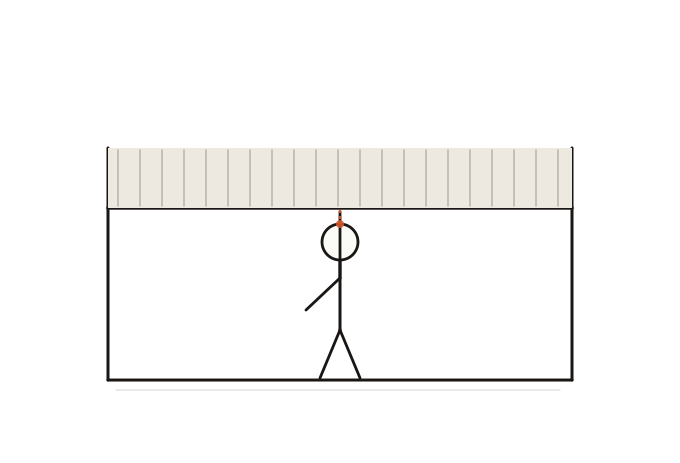
The ceiling is my hours. There are a fixed number of bootcamps I can run in a year. A fixed number of workshops I can facilitate. A fixed number of client engagements I can take on. Every one of them requires me, in the room, for a sustained period of time. The revenue scales linearly with my availability, and my availability has an upper limit.
There are obvious ways to raise the ceiling without changing the model. Train other facilitators. License the content. Build a certification programme. Create a network of accredited practitioners who can deliver the bootcamp using my materials.
These are all viable paths. People build excellent businesses this way. But they all share the same underlying assumption: the value is in facilitated delivery. You're still putting a person in the room. You're just making it a different person.
The question I keep returning to is more uncomfortable. What if the product itself could do the facilitation?
I don't mean facilitation in the full sense. The emotional intelligence, the reading of the room, the ability to catch a team going down a wrong track and redirect them gently. Those are human skills and I'm not pretending a system can replace them.
What I mean is the routing. The part where a team has diagnosed their problem and needs to know what to try. The chain of reasoning that connects "Group Values is the barrier, through Conformity vs Conflict as the mechanism" to "try this specific pattern, for this reason, and watch for this risk."
That reasoning is currently locked inside my experience. It's the thing the bootcamp teaches but that most participants can't fully replicate on their own afterwards. It's the thing that makes the system work beautifully in a facilitated setting and less well in an independent one.
If I could codify that reasoning, encode it in the system so that it's available without me or any other facilitator present, then BehaviourKit becomes something fundamentally different. A product that works at any time, in any room, for anyone who can describe their behaviour problem in plain language.
I'm not ready to build it yet. The system underneath isn't robust enough. The connections between drivers and patterns work, but they're still too loose for automated routing. The evidence base exists but it's not structured enough to back up recommendations with confidence levels. The safety considerations (what could go wrong if you try the wrong pattern in the wrong context?) are things I handle instinctively in workshops but haven't yet formalised.
All of that needs to happen before I can build a self-service product that I'd trust to give good advice without supervision.
But I want to name the aspiration clearly, so I can hold myself to it: BehaviourKit should be a product that works without Lauren in the room.
That's the thing I need to build next. And it's going to require me to make explicit everything that's currently implicit in how I work. Which is, when I think about it, the hardest kind of building there is.
Go deeper into the Building BehaviourKit series:
© 2026, BehaviourStudio All rights reserved. Behaviour Thinking is a registered trademark of BehaviourStudio.