
The audience changed while I was building
The people who most need this are not the people I built it for.
BUILDING BEHAVIOURKIT
Lauren Kelly
12/1/2023
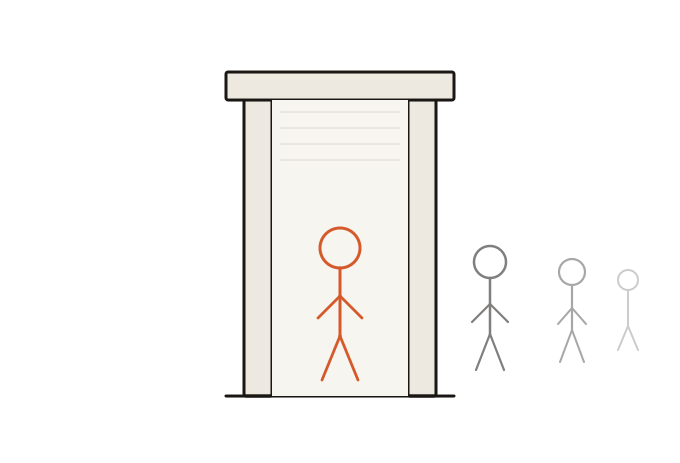
Something has happened gradually enough that I almost missed it. The people using BehaviourKit are no longer mostly designers.
When I started, the audience was clear: service designers, UX designers, product designers. People who already had empathy maps and journey maps but needed behavioural science tools to complement them. The card decks were designed for that world. The workshop format assumed that world. The language assumed that world.
Over the past two years, the bootcamp has brought in a different crowd. Change managers working on organisational transformation. L&D professionals trying to make training stick. Programme leads in public health. Policy teams in government. Product managers at tech companies trying to understand why users drop off after onboarding. Operations leads trying to get teams to adopt new processes.
These people share a common problem: they need to change what people do, and they don't have a structured way to approach it. They've tried training. They've tried communications. They've tried incentives. Something isn't landing, and they don't know why.
That problem is BehaviourKit's problem. It's the exact gap the system addresses. Diagnose why. Recommend what. Provide evidence for the recommendation. But the people experiencing this problem are not designers. They don't think in design terms. They don't work in sprints. They don't use Miro or Figma. They think in briefs, project plans, stakeholder meetings, and business cases.
This audience shift has implications I'm still working through.
The language needs to change. "Behavioural design" means something to a designer. It means very little to a change manager at a council. "We help you figure out why people aren't doing the thing, and what to try next" is longer but it lands with everyone. The system needs to speak in the language of the problem, not the language of the discipline.
The format needs to change. Card decks and workshop canvases assume a facilitated group session. Many of the people now using BehaviourKit work alone or in small teams without access to a facilitator. They need a tool they can use independently, at their desk, during a meeting, or on a train. The card deck format is charming and workshop-friendly and increasingly not how these people work.
The output needs to change. A designer wants inspiration and frameworks. A change manager wants a brief they can share with their team and their stakeholder. A product manager wants something they can put in a Jira ticket or a sprint planning document. The system needs to produce outputs that travel into those contexts without translation.
The depth needs to be optional. Designers often want to understand the mechanism. They enjoy the intellectual engagement. They like knowing WHY a particular approach works. Change managers and programme leads sometimes want that too, but more often they want: tell me what to do, show me the evidence, let me get on with it. The system needs to serve both preferences without forcing one on the other.
I'm realising that the audience I originally built for (designers) might end up being the smaller part of the market. The larger audience is anyone in any role who has a behaviour problem and needs to act on it with some confidence that their action is well-founded. That's a much bigger group. It's also a group with less tolerance for jargon, less patience for browsing, and more urgency about getting to a recommendation.
This changes the product fundamentally. A tool for designers can afford to be exploratory, rich, intellectually stimulating. A tool for "anyone with a people problem" needs to be direct, fast, plain-spoken, and focused on producing an actionable output.
The system underneath can be the same. The drivers, the levers, the patterns, the evidence, the routing logic. All of that serves both audiences. What changes is the surface: the language, the entry point, the pace, the output format, and the assumption about how much the user already knows.
I'm building for the broader audience now. The designers are still welcome. But they're no longer the primary constraint on the design.
Go deeper into the Building BehaviourKit series:
© 2026, BehaviourStudio All rights reserved. Behaviour Thinking is a registered trademark of BehaviourStudio.