
Nine cells and 148 questions
A diagnostic grid that works in 30 minutes and stalls at the 31st.
BUILDING BEHAVIOURKIT
Lauren Kelly
9/3/2021
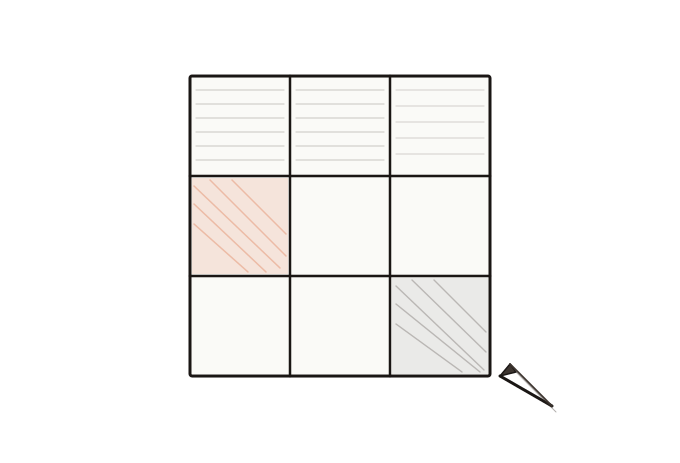
The Drive Grid is built and I've been testing it in workshops for a few months. I want to share what's working and what isn't, because the gap between the two is instructive.
What's working: the 3x3 structure lands immediately. I don't have to explain it for twenty minutes. People look at the grid, they see three rows (Self, Social, System) and three columns (Direct, Shift, Act), and they get it. Within five minutes they're using the language naturally. "I think the problem is in Group Values" or "We haven't thought about Pathways at all."
The diagnostic questions work too. I've written 148 of them, plain language, one or two per mechanism. Things like: "What do people feel about doing this?" and "What are the unwritten rules of the group?" and "What barriers stop people?" They're designed to be asked in a research interview, a team workshop, or a corridor conversation. When a team works through them, they end up with a map of what's driving the behaviour they're interested in. Typically within 30 minutes.
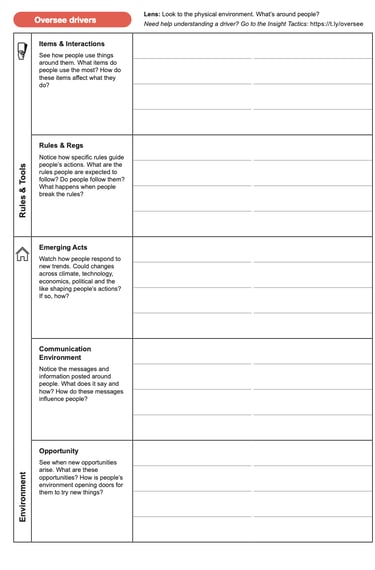
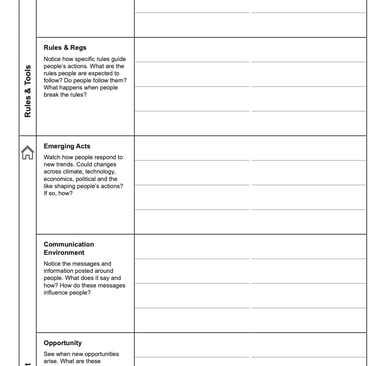
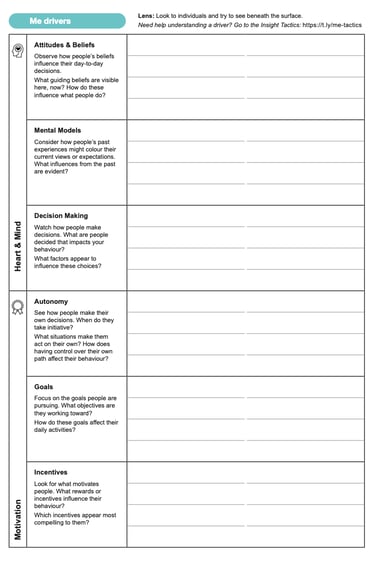
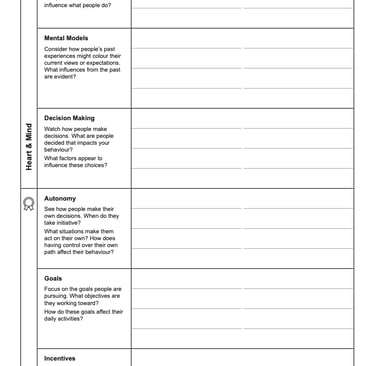
The red/green canvas is the simplest and most effective tool I've made. You take the grid, mark each cell as either helping (green) or hindering (red), and the visual pattern tells you where to focus. Lots of red in the Social row? That's where the problem lives. Green across the System row? The context is enabling; the issue is elsewhere. People engage with it quickly, and the output is immediately useful for prioritising where to look next.
Here's what isn't working: the action step.
Teams fill in the grid with enthusiasm. They identify the red zones. They have a clear picture of what's driving the behaviour. And then they look up and say, "Right. So what do we do about it?"
At which point they're looking at me.
The jump from "Heart & Mind is red" to "try this specific pattern" is too large. The patterns exist. Fifty-two of them. Organised into strategies. But matching a diagnosed driver to the right pattern requires a chain of reasoning that, at the moment, only I can do. I hold the connection logic in my head. The toolkit doesn't contain it.
In the workshop, this is fine. I'm the facilitator. Making those connections is part of what I'm there to do. But I'm increasingly aware that this creates a ceiling. The diagnostic half works independently. The pattern half works independently. What doesn't work independently is the bit in between. The reasoning that says: given this driver, in this state, affecting this stage of behaviour, here are the two or three patterns worth trying.
That reasoning is the chain I need to build. Driver connects to mechanism. Mechanism connects to strategy. Strategy connects to tactic. Tactic connects to pattern. It's a pipeline. Each stage narrows the options. And right now, I'm the narrowing.
One other thing I'm noticing. The grid forces an important discipline on teams: it makes them consider the social and contextual layers, which many teams skip over entirely. It's very common for a project team to focus exclusively on the individual (what do people think? what motivates them?) and ignore the group dynamics and structural factors that may be doing most of the work. The grid's visual structure makes those layers impossible to forget. That alone has value.
I'm also noticing that 9 driver types is the right number for facilitated work. Enough to cover the territory, few enough to hold in your head during a conversation. Whether it's the right number for a recommendation system, where the routing needs to be precise enough to discriminate between "people's attitudes are the problem" and "people's mental model doesn't match reality," is a question I'll need to come back to.
For now, I have a diagnostic tool that works. I have a pattern library that works. And I have a gap between them that I can fill by hand but not yet by design.
That gap is the next job.
Go deeper into the Building BehaviourKit series:
© 2026, BehaviourStudio All rights reserved. Behaviour Thinking is a registered trademark of BehaviourStudio.