
Lessons come from what we throw out
The graveyard taught me more than the library.
BUILDING BEHAVIOURKIT
Lauren Kelly
10/9/2020
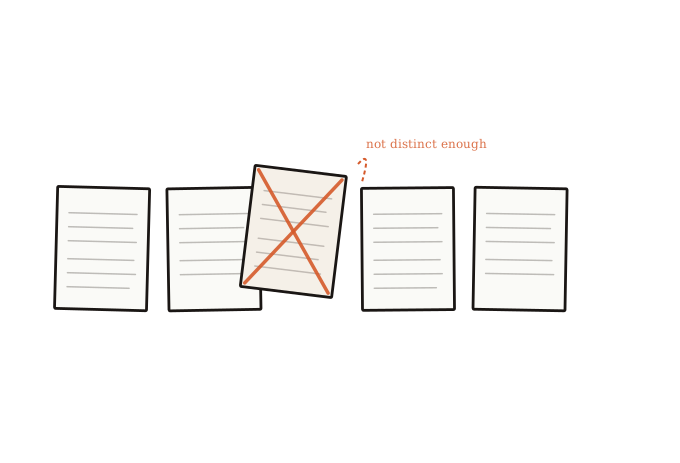
I want to talk about the graveyard.
Not the patterns that made the final list. The ones that didn't. The ones I named, examined, compared against every other pattern on the list, and then removed. With a reason. Written down.
The graveyard is growing faster than the library right now. I'm about 170 papers in. The candidate pattern list has had over 80 entries on it at various points. The current count of patterns I'm confident about is around 45. Which means I've removed roughly as many patterns as I've kept.
Each removal teaches me something that an addition doesn't.
When you add a pattern, you're saying: this is distinct, this is real, this is recurring. You feel good. The library grows. Progress is visible.
When you remove a pattern, you're saying: I was wrong about this being its own thing. It's actually a variant of something else. Or it's too vague to be useful. Or it sounds different but does the same mechanical work as an existing entry. You don't feel good. The library shrinks. It feels like going backwards.
But the removals are where the quality lives.
Take “Make the Future Felt.” I kept it as a pattern for a while. The move seemed clear enough: people are unaware of a risk, so an institution steps in with information about that risk and its consequences. On the surface, that looked distinct. But once I held it up against “Bring Tomorrow Closer,” it started to fall apart.
That pattern is also about helping people recognise risk, see that it applies to them, and do something with that understanding. Both patterns lean on consequences. Both close a gap in awareness. Both try to make risk more real.
At that point, keeping both starts to create false precision. It looks like two patterns. It is really one shape wearing slightly different clothes.
So “Make the Future Felt” went to the graveyard.
And the note I left was simple: too close to “Bring Tomorrow Closer.” Both rely on consequences and awareness of risk. The distinction was not strong enough to earn a separate place.
That note matters. Without it, I'd either forget why I removed it and add it back later, or I'd lose the insight that the removal provided. The graveyard isn't a bin. It's a record of decisions about what distinctiveness actually requires.
Here's what the removals have taught me so far.
Distinctiveness is harder to maintain than it looks. Two patterns can sound completely different (different names, different domain examples, different surface descriptions) while doing the same underlying work. The constant comparison method catches this, but only if you apply it honestly. The temptation is to keep both because they "feel" different. The discipline is to ask: if I removed one, would the other cover its territory? If yes, one goes.
Intuitive categories are seductive and unreliable. Early on, I was grouping patterns by domain: health patterns, sustainability patterns, workplace patterns. That felt natural. It also hid the fact that some patterns were domain-specific instances of the same mechanism. A "health communication" pattern and a "sustainability messaging" pattern might be doing identical work through identical mechanisms, just in different settings. Domain-based grouping encouraged duplication. Scale-based grouping (system level, community level, individual level) reduced it.
Naming creates attachment. Once a pattern has a name, especially a good name, it becomes harder to remove. "The Credible Inform the Eligible" has survived every round of comparison partly because the name is memorable. I have to be careful that I'm keeping patterns because they're genuinely distinct, not because I like saying their names.
The library should feel uncomfortably tight. If I look at the list and think "surely there should be more," that's probably a sign the quality is right. A loose library feels abundant. A tight library feels sparse. The sparse one is more useful, because every entry earns its place and practitioners can trust that the distinctions are real.
I think this applies beyond pattern libraries. Any classification system, any taxonomy, any curated collection benefits from a graveyard with reasons. The discipline of removal is the discipline of quality. And the things you remove tell you as much about your standards as the things you keep.
Go deeper into the Building BehaviourKit series:
© 2026, BehaviourStudio All rights reserved. Behaviour Thinking is a registered trademark of BehaviourStudio.