
Every road on the map at once
The difference between showing someone the whole system and helping them navigate it.
BUILDING BEHAVIOURKIT
Lauren Kelly
7/29/2022
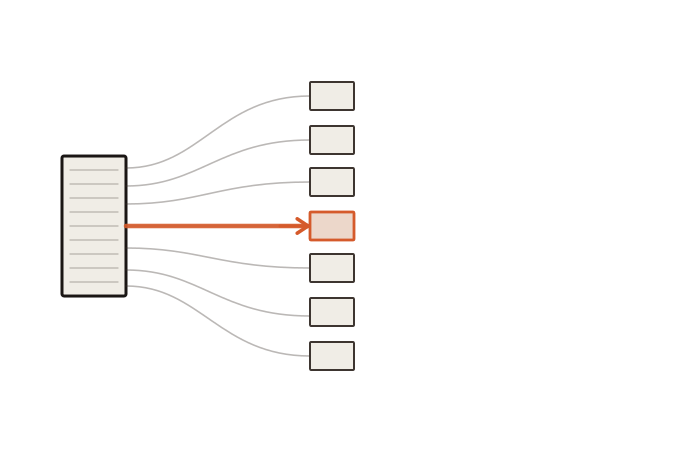
I've connected the two halves. Diagnosis on the left, prescription on the right, and a chain of logic running through the middle.
The chain works like this. You start with a driver (the thing you diagnosed using the grid). The driver points to one or more mechanisms (the specific aspect of the driver that's at play). The mechanism points to a strategy (the broad approach for addressing it). The strategy points to a tactic (the type of move). The tactic points to a pattern (the specific, named intervention).
Driver. Mechanism. Strategy. Tactic. Pattern. Five nodes in a chain.
If you diagnose Heart & Mind as the driver and Mental Models as the mechanism, the chain takes you through Persuade as a strategy, Focus as a tactic, and lands you on patterns like "Highlight Outcomes" or "Show Consequences." Each step narrows the field. By the end, you're looking at two or three patterns that are genuinely relevant to what you've diagnosed, rather than staring at fifty-two and guessing.
I built an interactive Sankey diagram to visualise the whole system. It's a type of flow chart where the width of each connection shows how dense the route is. You can click on any driver and watch the connections cascade through mechanisms, strategies, tactics, and patterns. The result is, honestly, quite beautiful. Nine drivers fanning through 26 mechanisms, through eleven strategies, through various tactics, arriving at around 56 named patterns. Some routes are wide and well-trodden. Others are narrow threads.
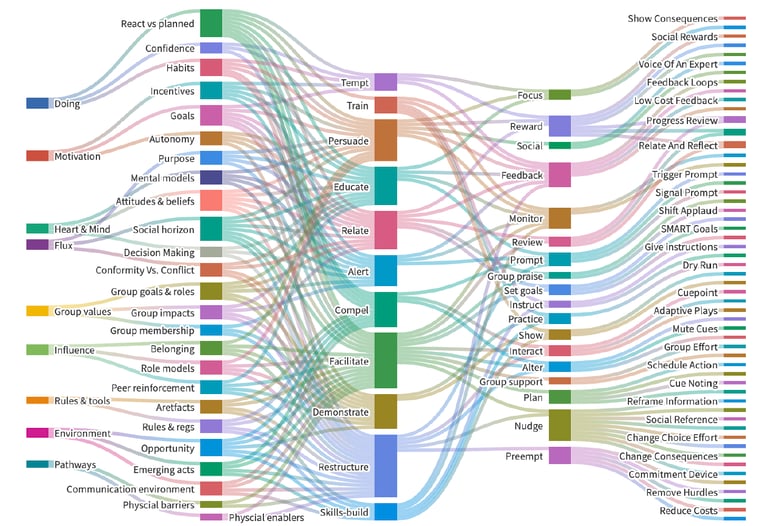
The Sankey does something I've wanted since 2018. It shows that BehaviourKit isn't two separate products glued together. It's one system. The diagnosis and the prescription are connected by traceable logic. Understanding flows into action.
I'm proud of it. And I've also discovered its limitation.
I showed the Sankey to a few teams over the past fortnight. The designers loved it. They could see the system's architecture. They appreciated the comprehensiveness. A few of them spent a happy fifteen minutes clicking through all the routes and making satisfied noises.
But when I asked whether it helped them choose what to do for their specific problem, the answer was consistently some version of "not really."
The Sankey shows all possible paths. Every valid route from every driver to every pattern. Which is useful for understanding how the system is structured. And thoroughly unhelpful for making a decision.
I keep coming back to a transport analogy. The Sankey is like opening a map application and being shown every road in the country at the same time. You can see the motorways, the A-roads, the back lanes, the cycle paths. You can appreciate the network. You can zoom in and out and admire the detail. What you cannot do is figure out the best route from your house to the shops.
For that, you need a satnav. Something that knows where you are, where you want to go, what the conditions are like, and which route is sensible given all of that. Something that says: take this one. Turn here. In 200 metres, bear left.
The Sankey is a map. What people need is a satnav.
I'm sitting with this realisation, because it's important. Building the map was necessary work. The connections are real. The chain logic is sound. The architecture holds up. But the user experience of navigating it is wrong for the people I'm trying to serve. They don't want to see everything. They want the system to see everything and then tell them the relevant bit.
Constraint, again. The same lesson from the very first workshops. When I hand someone three cards, they engage. When I hand them twenty, they freeze. The map is all twenty at once. The satnav is the three.
I don't know how to build the satnav yet. The chain helps, because it narrows the options step by step. But the chain still requires the user to make choices at each stage (which mechanism? which strategy?) and those choices require a level of understanding that my target audience doesn't have.
The system needs to make more of those choices automatically. Based on the input. Based on the diagnosis. Based on the state of things.
That's the next piece. And it's the hardest one so far.
Go deeper into the Building BehaviourKit series:
© 2026, BehaviourStudio All rights reserved. Behaviour Thinking is a registered trademark of BehaviourStudio.