
A quarter million strangers and half a system
What 250,000 impressions taught me about the difference between reach and usefulness.
BUILDING BEHAVIOURKIT
Lauren Kelly
10/16/2020
I've reached a kind of finished. The kind where new papers keep arriving but they're wearing the same clothes as papers I've already read. The patterns have stopped being new. The set is settling.
52 distinct behaviour change patterns. Each one has a name, a recurring problem it addresses, a structure for how the intervention works, the mechanism underneath it, and examples across multiple domains. They're grouped into 10 strategies, which are broader families that share a common mechanism type: persuade, educate, tempt, compel, and so on.
I shared them on LinkedIn last week. A summary post. The names. What each pattern does. Plain language. Nothing dressed up.
250,000 impressions.
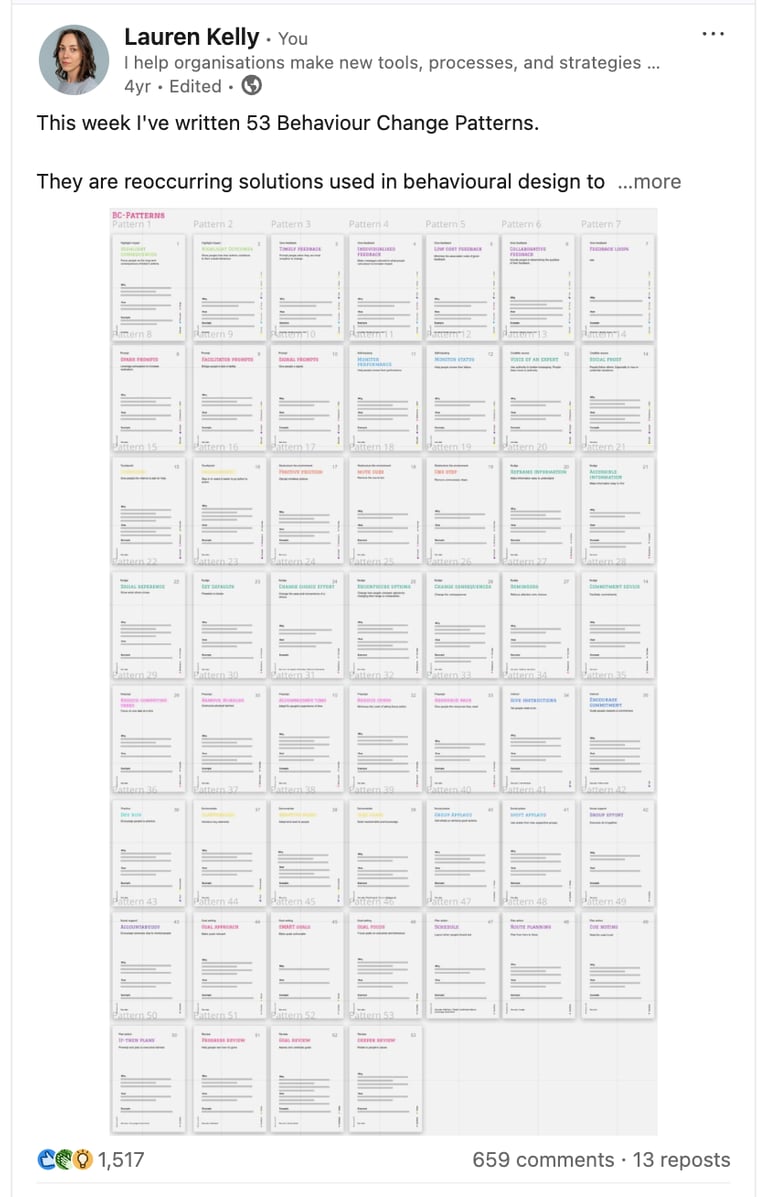
I genuinely did not see that coming. The post isn't clever or provocative. It's just a list of named intervention patterns with short descriptions. The response tells me something I'd suspected but had no way to confirm: practitioners across multiple fields are hungry for exactly this kind of resource. Structured, evidence-grounded intervention patterns they can actually use in their work. The behavioural science community, the design community, the change management community, the L&D community. The appetite is broad.
People are sharing it with colleagues. A few people I've never met have messaged to say they've printed the list and pinned it to their wall. One person in Estonia asked if they could use it in a university course.
Which is wonderful. And also slightly alarming. Because what I've shared is a list. A well-researched, carefully curated list with names and descriptions and examples. A very good list, I think. But a list all the same.
A list gives you options. It does not give you direction.
I know this intimately, because I've spent months living with these patterns and I still have to think carefully about which one fits a particular situation. The selection logic isn't in the list. It's in my head. The knowledge that says "given what you've described, start with this one" lives in the space between the patterns and the problem. The list doesn't occupy that space. I do.
There's a phrase that keeps forming in my thinking and I should probably write it down properly: half a system.
The patterns tell you what to try. That's the "change behaviour" half. But they don't tell you why people are behaving the way they are. The diagnostic half, the "understand behaviour" half, is missing. Without it, selecting a pattern is guesswork. Educated guesswork, if you know the domain. Wild guesswork, if you don't.
Think of it like a pharmacy with well-stocked shelves and clear labels, but no doctor. You walked in feeling unwell. Everything on the shelf could theoretically help. Some of it will. Most of it won't. The shelves aren't the problem. The missing diagnosis is.
This is the thing I need to build next. And I know it will be harder than the patterns, because cataloguing interventions is one thing. Cataloguing the underlying drivers of human behaviour is a much larger, more contested, and more theoretically tangled problem.
But the patterns proved something important: behaviour change interventions follow recurring shapes. They are not unique snowflakes. If I can show the same thing about behavioural drivers, about the reasons people do and don't act, then I can connect the two halves. Diagnosis flowing into prescription. Understanding flowing into action.
In the meantime, 250,000 people have seen the patterns. Some of them will use them well. Some will use them badly. Some will print them out and never look at them again. That's how it goes with any resource. The thing I can control is what I build next.
And what I build next is the missing half.
Go deeper into the Building BehaviourKit series:
© 2026, BehaviourStudio All rights reserved. Behaviour Thinking is a registered trademark of BehaviourStudio.