
A friend said something that changed everything
How a casual remark on a video call led to the biggest structural shift in seven years.
BUILDING BEHAVIOURKIT
Lauren Kelly
3/21/2025
I was on a call with a friend last month. Someone who'd used BehaviourKit in an earlier version, back when it was mostly card decks and workshop facilitation. We were catching up, and I was describing the current state of the system. The drivers, the levers, the plays, the matrix I was trying to build, the routing logic.
She listened for a while and then said, "What you're building reminds me of TRIZ. Have you heard of it?"
I had not.
TRIZ, it turns out, is an engineering methodology created by a Soviet inventor and patent analyst called Genrich Altshuller, starting in the 1940s. He spent years reviewing patents, eventually analysing over 400,000, and found that inventive solutions follow recurring patterns. He identified 40 inventive principles that crop up across completely different engineering domains. And he built a contradiction matrix: a structured lookup where you describe what you're trying to improve and what gets worse when you try, and the matrix points you toward the principles most likely to resolve that specific contradiction.
I started reading. And the parallels were not subtle.
Altshuller catalogued hundreds of thousands of patents and found recurring solution patterns. I catalogued hundreds of behaviour change projects and found recurring intervention patterns. He organised his findings by problem type. So did I. He built a matrix that routes from a contradiction to a principle. I've been trying to build a system that routes from a diagnosed problem to a recommended intervention.
The structural similarity is uncanny. Two people, in completely different fields, separated by decades, arriving at the same approach: catalogue what's been tried, find the patterns, build a routing system that connects problems to solutions through structured logic.
But the thing that really changed my thinking wasn't the similarity in method. It was the contradiction framing.
TRIZ doesn't ask "what's the problem?" It asks "what's the contradiction?" Meaning: what are you trying to improve, and what gets worse when you try to improve it? You want to make a component lighter, but making it lighter makes it weaker. That's the contradiction. The inventive principle is the move that resolves the contradiction, improving one property without worsening the other.
Applied to behaviour change, this reframes the entire routing question.
The old question was: "What's the barrier?" Identify the driver, find the pattern, try it. Linear. Reasonable. Incomplete.
The new question is: "What's the contradiction?" You want to help people start a new behaviour, but doing so adds effort. You want to reduce drop-off, but doing so increases exposure and judgement. You want to stop the old behaviour, but doing so clashes with how work actually flows.
That's a richer question. It captures the tension that practitioners actually live with. Every behaviour change intervention has side effects. Every improvement risks worsening something else. The useful question is: how do you improve the goal without making the constraint worse?
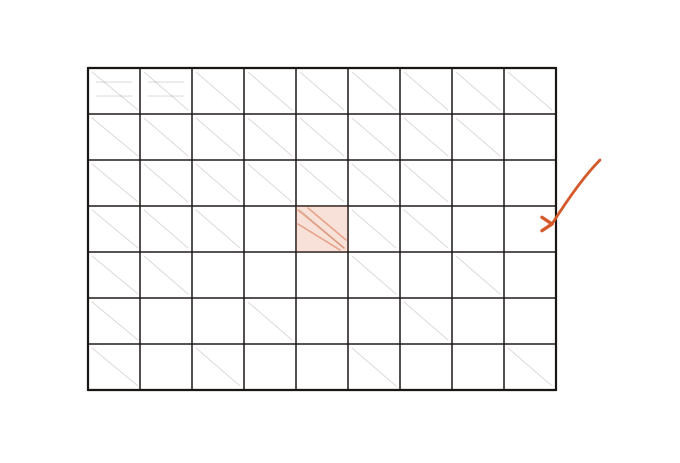
So I started experimenting with a contradiction matrix for behaviour change. Seven improvement goals (help people start, reduce drop-off, improve quality, make it reliable, make it last, help it spread, stop the old behaviour). Nine worsening constraints (adds effort, adds time, increases exposure, feels imposed, increases mistakes, clashes with workflow, politically awkward, blocked by rules, hard to measure).
Seven by nine. Sixty-three cells. Each cell is a specific contradiction. And each cell can be mapped to the principles and plays most likely to resolve that particular tension.
I spent the rest of the week building it. And something clicked that I haven't felt since the patterns first emerged from the lockdown cataloguing. The system stopped being a taxonomy with routing bolted on. It became a contradiction-resolution engine.
That's a different kind of product. A product that says: tell me what you're trying to do, and tell me what keeps getting in the way, and I'll find you the move that makes progress without making things worse. That's what practitioners actually need. And now I have a structured way to deliver it.
I keep thinking about the fact that I didn't find TRIZ through research. A friend mentioned it in conversation. The most important structural insight in seven years of building came from a casual remark on a video call. Which probably says something about the value of staying connected to people who think differently from you.
Go deeper into the Building BehaviourKit series:
© 2026, BehaviourStudio All rights reserved. Behaviour Thinking is a registered trademark of BehaviourStudio.