
A card-based system for diagnosing and shifting AI adoption behaviour
INSIGHTSAI ADOPTION
2/2/20263 min read
A card-based system for diagnosing and shifting AI adoption behaviour
Patterns, Profiles, Playbooks: how the toolkit works
When we set out to build tools for AI adoption, we had one constraint: whatever we made had to work without us in the room.
Consultants often build frameworks that require consultants to run. We wanted the opposite. A system that a team lead, a change manager, or a facilitator could pick up and use—with their own teams, in their own context, without external support.
The result is a card-based toolkit with three layers: Patterns, Profiles, and Playbooks. This piece explains how they work and how they fit together.
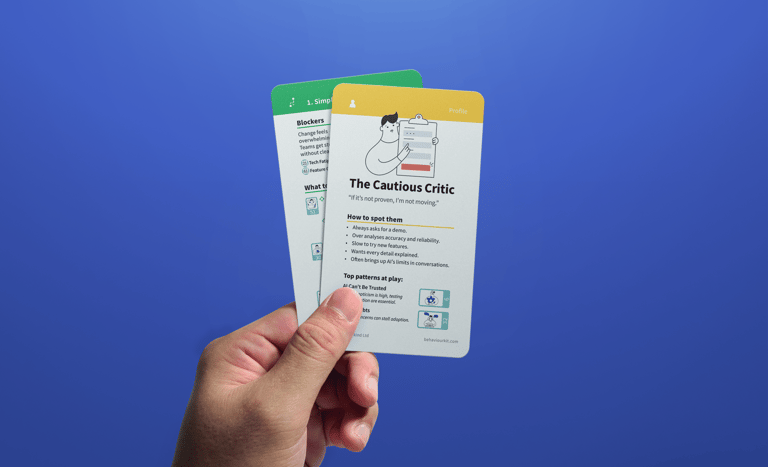
Why cards?
Cards work for behaviour tools because they're:
Modular. You don't have to use all of them. Pick the ones relevant to what you're seeing.
Discussable. You can put a card on the table and ask "does this happen here?" It makes abstract friction concrete and talkable.
Usable in the moment. You don't need to read a manual first. Each card is self-contained.
Sharable. Teams can pass them around, mark them up, stick them on walls.
The three types of cards serve different purposes in a diagnostic or intervention session.
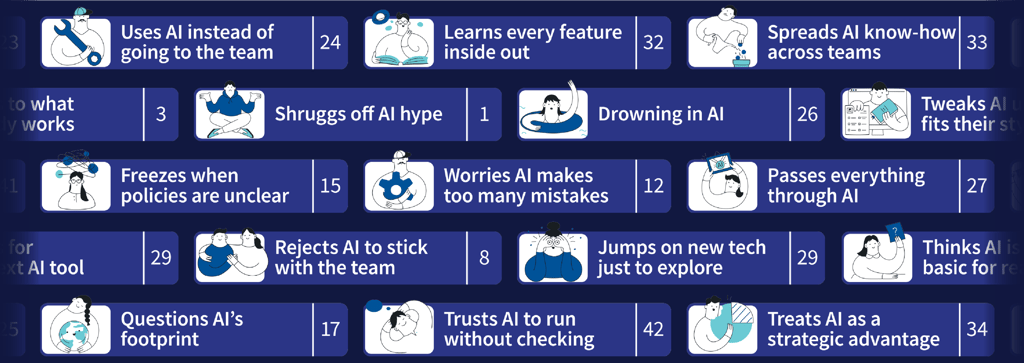
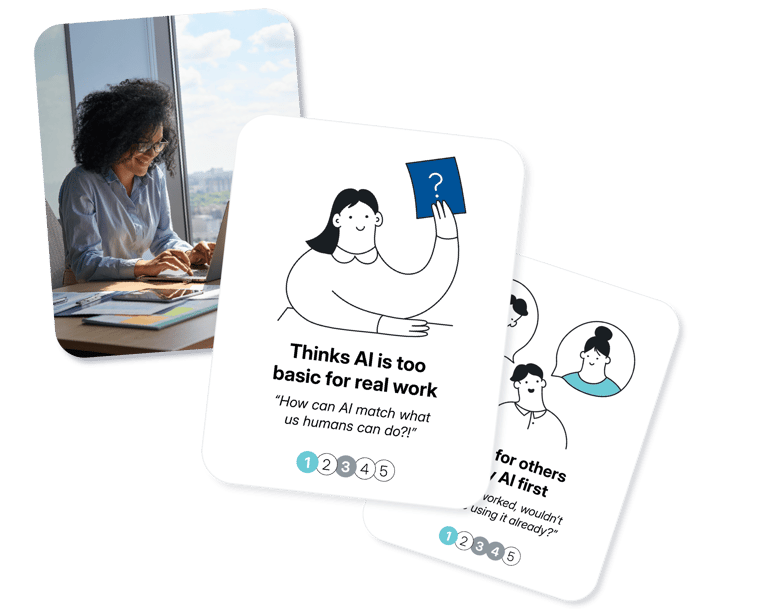
Pattern cards
What people do
The common behaviours that slow AI use down, or push it forward.
What's on a card:
The pattern name (e.g., "Worries AI makes too many mistakes")
What it looks like in practice
Why it happens (the drivers behind it)
What it costs (the consequences if unaddressed)
Which lever it maps to
How to use them:
In a team session, spread relevant Pattern cards on the table. Ask people to identify which ones they recognise. In their own team, in teams they work with, in the organisation broadly.
This does two things. First, it gives people language for friction they've felt but couldn't name. "Worries AI makes too many mistakes" or "Uses AI instead of going to the team" become handleable concepts rather than vague frustrations.
Second, it creates psychological safety to talk about problems. You're not accusing anyone of doing something wrong. You're pointing to a card and asking "does this happen here?" The card takes the weight.
Profile cards
How people think about AI
The mindsets behind every AI reaction.
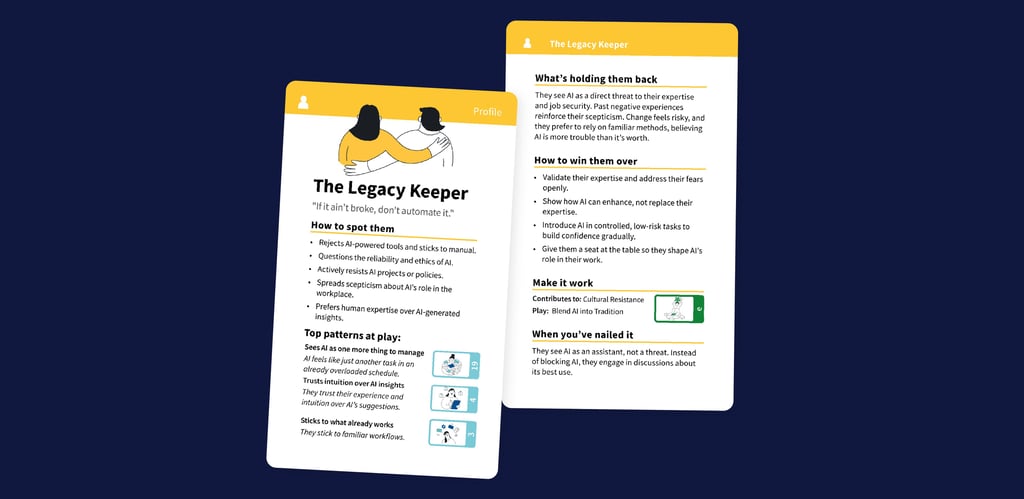
What's on a card:
The profile name (e.g., "The Enthusiast," "The Sceptic")
How this person typically engages with AI
What drives their behaviour
What interventions tend to work for them
What doesn't work
How to use them:
Profile cards help facilitators read the room. In any team, you'll have a mix of orientations toward AI. Some people are eager adopters who share what they're learning. Some are excited in theory but rarely use AI in practice. Some are sceptical and need a compelling reason to engage. Some are actively resistant.
A one-size-fits-all approach (the same training, same messaging, same expectations) will connect with some and alienate others. Profile cards help you adjust.
They're also useful for building empathy across a team. When the enthusiast understands why the sceptic is hesitant (and vice versa), conversations become more productive.
Playbook cards
Quick starts to common challenges
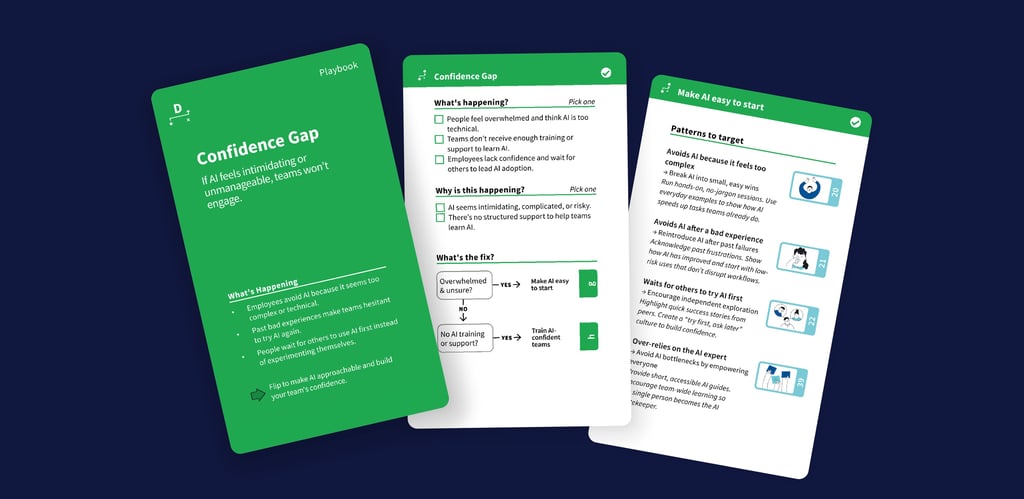
Once you've identified the friction (using Patterns) and understood the room (using Profiles), Playbook cards give you something to do about it.
Each Playbook is designed to run in a real meeting, with a real team, in a realistic amount of time. They plot the path through behaviour, making it easier to see and work with.
How the three layers fit together
A typical flow:
Start with Patterns. What friction is this team experiencing? Which patterns do they recognise?
Consider Profiles. Who's in the room? What mix of orientations are you working with? How might that shape what you do?
Pick Playbooks. Based on the friction you've identified and the room you're working with, which interventions make sense?
You don't always need all three. Sometimes you just need Pattern cards to get a conversation started. Sometimes you already know the friction and just need a Playbook. The layers are modular, use what serves the moment.
Getting the toolkit
The card-based toolkit is part of Human-AI Performance, the adoption system we built with Infosys Consulting. Contact us to get the toolkit and book your AI Behaviour Sprint.
For the full case study, see Infosys Consulting → Human-AI Performance.
© 2026, BehaviourStudio All rights reserved. Behaviour Thinking is a registered trademark of BehaviourStudio.